Version Control Systems: The Foundation of Modern Software Delivery
When I wired together GitHub Actions, PM2, and a Proxmox VM as a self-hosted runner for a Node.js Express API, I quickly discovered that the pipeline itself was the straightforward part. The hard part was everything that happened before the pipeline even triggered: how code was branched, committed, reviewed, and merged. Version Control Systems (VCS) are the foundation on which everything else rests, and getting that foundation wrong is expensive.
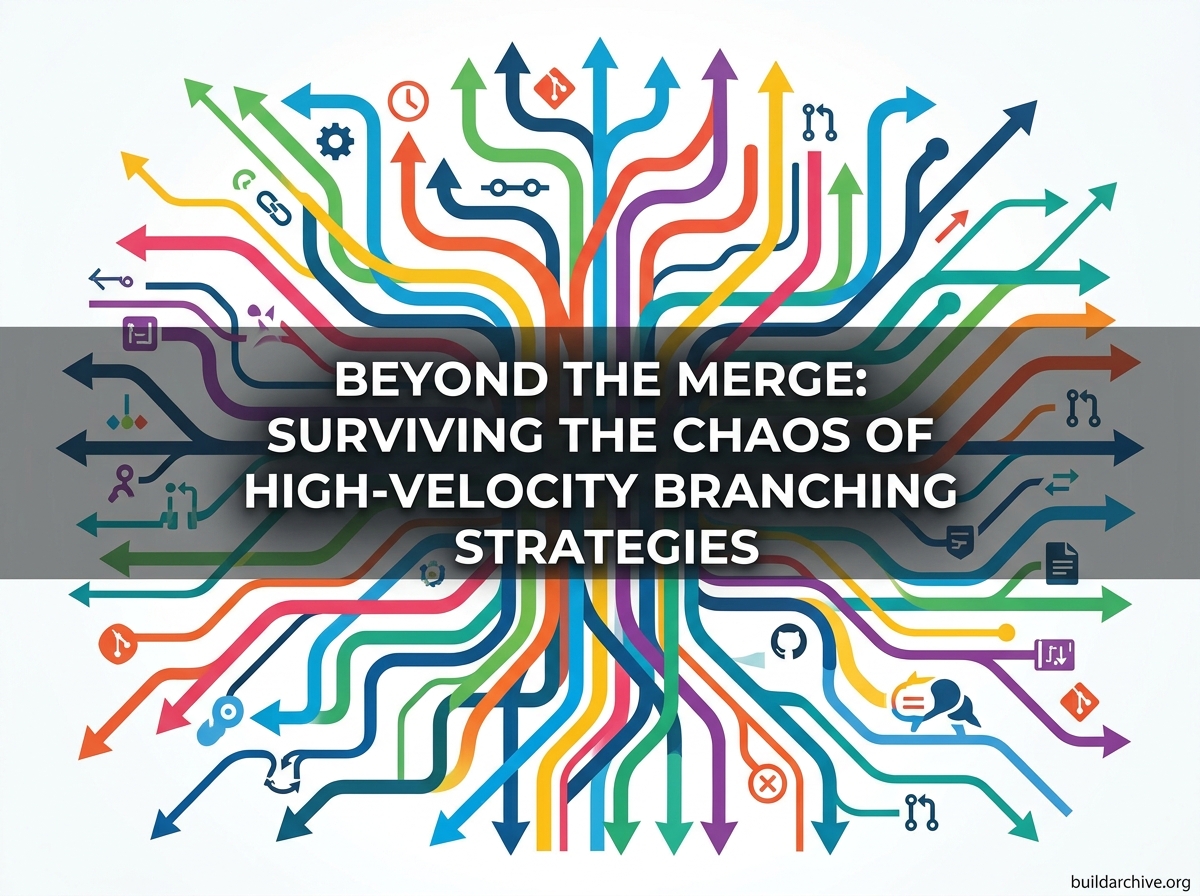
Here is the reality that many tutorials skip: version control is less about the tool (be it Git, Mercurial, or SVN) and more about the human workflow. I have seen teams with expensive CI/CD tooling crumble because their branching strategy was a tangled web of long-lived feature branches and emergency hotfix patches that required serious archaeology to untangle. Managing code is managing communication. When two developers work on the same file, they are not just writing logic — they are negotiating the future state of the product. This post goes beyond the basic git commit and into the strategic heart of modern software delivery.
The Great Branching Debate: GitFlow vs. Trunk-Based Development
Every organization eventually hits a crossroads where they must decide how their developers will collaborate. This decision dictates the speed of the entire delivery pipeline. In my experience, there is no perfect strategy, only the one that fits your team’s maturity and your product’s release cycle.
The GitFlow Legacy
GitFlow was, for years, the gold standard. It provides a strict framework with dedicated branches for features, releases, and hotfixes. While it offers a sense of security and order, it often leads to what I call “Merge Debt.” I once worked on a project where a feature branch stayed open for three months. When the time came to merge it back into develop, the resulting conflicts were so severe that it took three engineers an entire week just to resolve the logic discrepancies. The longer a branch lives in isolation, the more expensive that isolation becomes.
The Shift to Trunk-Based Development
As teams move toward Continuous Delivery, Trunk-Based Development (TBD) has become the preferred choice for high-performing engineering organizations. In TBD, developers merge small, frequent updates to a single trunk — usually the main branch. This approach forces a set of healthy habits into the daily workflow.
- Integrate early and often: Conflicts are discovered in minutes, not months, because nobody is sitting on a divergent branch for weeks at a time.
- Utilize Feature Flags: Since code is merged into
mainbefore it is ready for users, developers use conditional logic to hide unfinished features at the application layer rather than at the Git layer. - Maintain a green build: Because everyone works off the trunk, any break in the build halts the entire team, which fosters a culture of collective responsibility around code quality.
The core principle is that the difficulty of a merge is roughly proportional to the time the branch has spent separated from the trunk. Merging frequently is not just a workflow preference — it is risk management.
Lessons from the Trenches: When VCS Goes Wrong
To truly master version control, you need to understand the pitfalls that appear under real pressure. Here are three situations I have either experienced or watched unfold, and what each one taught me about building a healthier DevOps culture.
1. The “Ghost in the Machine” Rebase
Early in my career I was a strong advocate for git rebase over git merge to keep a clean, linear history. Then one afternoon I rebased a shared branch that three other developers were actively working on. By rewriting the history, I effectively orphaned their local commits, leading to a chaotic afternoon of manual code recovery and some tense Slack messages.
The lesson: Never rebase branches that have been pushed to a shared repository. Reserve rebasing for your local cleanup — tidying up your own commits before you open a pull request and share your work with the team.
2. The Monorepo vs. Polyrepo Struggle
As you scale microservices, the question of repository structure becomes unavoidable. I have managed a polyrepo setup with over 50 individual repositories. While it provided clean isolation per service, cross-service changes became a coordination nightmare — updating a shared TypeScript interface meant opening PRs across a dozen repos simultaneously and hoping the timing lined up. We eventually transitioned closely coupled services into a monorepo, which allowed atomic commits across multiple packages. A breaking change in an API contract could be updated in the consuming client within the same commit. The trade-off was real, though: we needed significant investment in our CI tooling to avoid rebuilding all 50 services every time someone fixed a typo in a README.
3. The Accidental Secret Leak
A developer once pushed a .env file containing a live AWS secret key to a public GitHub repository. Within 60 seconds, automated bots had scraped the key and started spinning up EC2 instances for crypto mining. The damage was financial and immediate.
The lesson: VCS security must be automated and enforced before the push, not after. We now use pre-commit hooks combined with tools like Gitleaks or TruffleHog to scan every commit before it leaves the developer’s machine. Here is a minimal example of a .pre-commit-config.yaml that wires in Gitleaks:
repos:
  - repo: https://github.com/gitleaks/gitleaks
    rev: v8.18.2
    hooks:
      - id: gitleaks
        name: Detect hardcoded secrets
        entry: gitleaks protect --staged --redact
        language: golang
        pass_filenames: false
This runs automatically on every git commit attempt and blocks the commit if a secret pattern is detected. The reason it works where post-push scanning fails is simple: by the time a secret reaches a remote repository — even a private one — you have already lost control of the exposure window. Pre-commit hooks keep the secret local and give the developer an immediate, actionable error rather than a post-incident audit.
Best Practices for a Robust VCS Strategy
To ensure your version control setup supports a healthy software delivery lifecycle, these are the practices I consistently return to regardless of team size or stack.
- Small, atomic commits: Each commit should do one thing only. This makes it significantly easier to
git reverta specific change if a bug surfaces in production without rolling back unrelated features alongside it. - Standardized commit messages: Follow a convention like Conventional Commits — for example,
feat: add login validationorfix: resolve memory leak in worker thread. This enables automated changelog generation and makesgit logactually readable six months later. - Protected branches: Never allow direct pushes to your
mainor production branches. Require Pull Requests with at least one peer review and a passing CI build as mandatory gates. - Automated linting and testing as gatekeepers: If code does not meet the style guide or fails a unit test, the PR should be blocked automatically. Catching issues at the VCS layer — before they reach staging or production — is far cheaper than catching them later.
On the Node.js side specifically, wiring a lint check into your CI pipeline is straightforward. A minimal GitHub Actions workflow for a TypeScript Express project might look like this:
name: CI

on: [pull_request]

jobs:
  lint-and-test:
    runs-on: ubuntu-latest
    steps:
      - uses: actions/checkout@v4

      - name: Setup Node
        uses: actions/setup-node@v4
        with:
          node-version: '20'

      - name: Install dependencies
        run: npm ci

      - name: Run ESLint
        run: npm run lint

      - name: Run tests
        run: npm test
The npm ci command (rather than npm install) is intentional here — it installs exactly what is in package-lock.json with no creative interpretation, which makes your CI builds reproducible and prevents the classic “works on my machine” failure mode. In a TypeScript Express project, that predictability compounds over time: you are not just linting code, you are asserting that the environment itself is consistent between every developer’s machine, your Proxmox runner, and whatever cloud environment eventually receives the artifact.
Enforcing Commit Message Standards Programmatically
Conventional Commits are easy to agree on in a team meeting and easy to ignore under deadline pressure. The only way to make the standard stick is to enforce it automatically. The following commitlint configuration, combined with a Husky pre-commit hook, rejects any commit message that does not match the expected pattern before it ever enters the repository history:
// commitlint.config.js
module.exports = {
  extends: ['@commitlint/config-conventional'],
  rules: {
    'type-enum': [
      2,
      'always',
      ['feat', 'fix', 'docs', 'chore', 'refactor', 'test', 'perf', 'ci']
    ],
    'subject-max-length': [2, 'always', 72]
  }
};
Pair this with a .husky/commit-msg hook that runs npx --no -- commitlint --edit "$1" and the standard becomes self-enforcing. The practical payoff is a git log that reads like a structured changelog rather than a stream of consciousness — which matters enormously when you are trying to diagnose a production regression in a MongoDB collection that was quietly restructured three weeks ago.
A Note on Pull Request Culture
The code review is the most important cultural touchpoint in the VCS workflow. It should not feel like a policing action but a knowledge-sharing session. Tone matters enormously in written reviews — a suggestion framed as a question (“What do you think about extracting this into a separate service?”) lands very differently than a command. Teams that treat reviews as learning opportunities, not approval checkpoints, tend to produce better code and keep engineers around longer.
Conclusion: The Foundation of Continuous Delivery
Version control systems are far more than undo buttons for programmers. They are the engine rooms of modern software delivery. By choosing a branching strategy that matches your team’s pace, enforcing security through automated pre-commit hooks, and building a pull request culture grounded in learning rather than gatekeeping, you transform your VCS from a source of friction into a genuine competitive advantage.
Whether you lean on the structured safety of GitFlow or the high-velocity rhythm of Trunk-Based Development, the goal is the same: delivering value to users as safely and quickly as possible. Take a look at your current repository today — is it a clear map of your team’s progress, or a tangled forest of forgotten branches? It might be time for a cleanup.