Introduction
When I started breaking apart a monolithic Express application into smaller services on my Proxmox homelab, I quickly learned that the architectural diagram on paper and the operational reality at 2am are two very different things. The transition to Microservices Architecture represents a fundamental shift in how we conceive, build, and scale digital products — and it deserves a grounded, practical look.
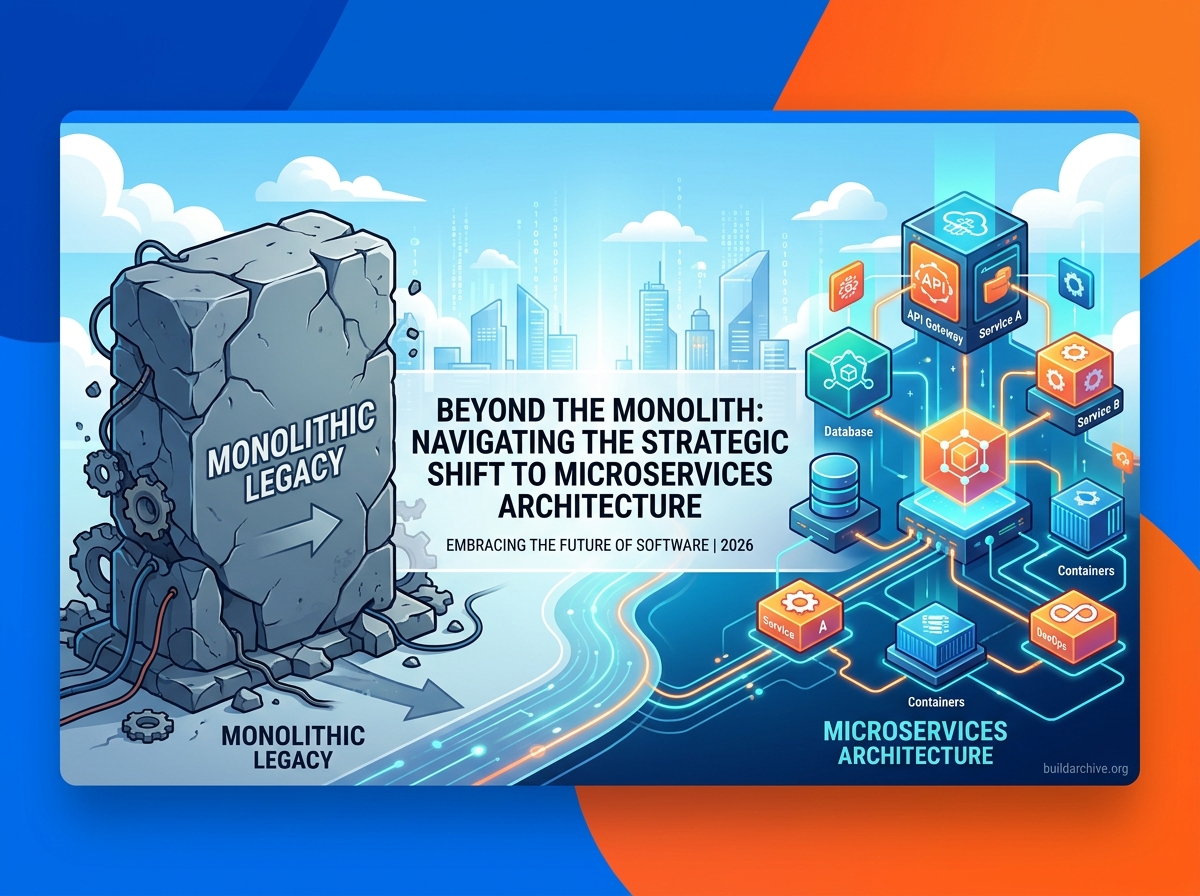
For years, the monolith was the standard: a single, unified unit where the user interface, business logic, and data access layers were tightly interwoven. While simple to develop initially, these systems eventually become “balls of mud,” where a single change in one module can trigger unexpected failures in another, and scaling requires replicating the entire application regardless of which component is actually under stress.
Microservices offer a compelling alternative by breaking the application into a collection of small, autonomous services. Each service is modeled around a specific bounded context, owns its own data, and communicates over lightweight protocols like HTTP/REST or gRPC. This architectural style aligns naturally with modern DevOps culture, enabling teams to deploy faster, scale more efficiently, and embrace technological diversity. However, microservices are not a silver bullet. They introduce significant operational complexity, requiring a solid understanding of distributed systems, service discovery, and inter-service communication. This post covers the core design principles behind microservices, practical communication patterns, and the operational realities of running them in production.
The Core Principles of Microservices Design
To succeed with microservices, architects must move beyond the “how” and focus on the “why” and “where.” A poorly designed microservices architecture often results in a distributed monolith — something that combines the complexity of distributed systems with the rigidity of a monolith. To avoid this, there are several foundational principles worth internalizing before writing a single line of code.
Bounded Contexts and Domain-Driven Design (DDD)
The most critical step in designing microservices is defining where one service ends and another begins. Following the principles of Domain-Driven Design (DDD), we identify “Bounded Contexts.” A bounded context is a natural boundary within a business domain where a particular model applies. In an e-commerce platform, for example, the “Product” entity means something different to the Inventory Service (stock levels, warehouse location) than it does to the Marketing Service (promotional images, customer reviews). By separating these into distinct services, we ensure that changes in marketing logic cannot inadvertently break inventory tracking.
Decentralized Data Management
In a monolithic architecture, a single centralized database is the norm. In microservices, this becomes a major anti-pattern. Each microservice should own its own private database. This enforces loose coupling at the data layer — no two services should ever share a database schema. If Service A needs data from Service B, it must request it via an API call or consume an event. This rule prevents “integration at the database level,” which is historically one of the hardest dependencies to untangle in legacy systems.
In practice, this means you might run a MongoDB instance for your user profile service while the billing service talks to PostgreSQL. Docker makes this straightforward to manage locally. Each service gets its own container and its own volume, and they never touch each other’s data directly.
Design for Failure
In a distributed system, failure is not an edge case — it is an expected condition. A network partition, a slow database query, or a crashing container can happen at any moment. Microservices must be designed to be resilient from the start. This involves implementing patterns such as Circuit Breakers (preventing a failing service from cascading failures across the system), Retries with Exponential Backoff (intelligently retrying failed requests without overwhelming a downstream service), and Bulkheads (isolating thread pools or connection limits so a failure in one area does not consume all available system resources).
Communication Patterns: Synchronous vs. Asynchronous
How services talk to each other largely determines the responsiveness and reliability of your overall system. There are two primary models to understand.
Synchronous Communication (Request/Response)
This is typically handled via REST over HTTP or gRPC. It is straightforward to implement and easy to reason about. The tradeoff is temporal coupling — Service A must wait for Service B to respond. If Service B is slow, Service A becomes slow too. For this reason, synchronous communication works best for internal queries where the user is actively waiting for an immediate response, such as fetching a product detail page that requires up-to-date inventory data.
Here is a simple example of one Node.js/Express service calling another synchronously using the native fetch API available in Node 18+:
// order-service/src/routes/orders.ts
import express, { Request, Response } from 'express';

const router = express.Router();
const INVENTORY_SERVICE_URL = process.env.INVENTORY_SERVICE_URL || 'http://inventory-service:3001';

router.post('/', async (req: Request, res: Response) => {
  const { productId, quantity } = req.body;

  try {
    // Synchronous call to inventory service before creating the order
    const inventoryRes = await fetch(`${INVENTORY_SERVICE_URL}/stock/${productId}`);

    if (!inventoryRes.ok) {
      return res.status(502).json({ error: 'Inventory service unavailable' });
    }

    const { available } = await inventoryRes.json() as { available: number };

    if (available < quantity) {
      return res.status(400).json({ error: 'Insufficient stock' });
    }

    // Proceed with order creation...
    res.status(201).json({ message: 'Order created', productId, quantity });
  } catch (err) {
    // If inventory service is down entirely, we fail fast rather than hang
    res.status(503).json({ error: 'Could not reach inventory service' });
  }
});

export default router;
The key thing to note here is the explicit error handling on both a non-OK HTTP status and a network-level failure. In a distributed system, both scenarios happen regularly, and silently swallowing them leads to debugging nightmares.
Asynchronous Communication (Event-Driven)
In a mature microservices ecosystem, Event-Driven Architecture (EDA) is often the preferred model for operations that do not require an immediate response. Instead of Service A calling Service B directly, Service A publishes an event — for example, order.created — to a message broker like Apache Kafka or RabbitMQ. Any service interested in that event, such as Shipping or Notifications, consumes it and acts accordingly.
This approach offers real advantages: services can process events at their own pace without blocking the producer, the order service continues functioning even if the notification service is temporarily down, and the producer does not need to know anything about who its consumers are. The tradeoff is that eventual consistency becomes the norm rather than the exception, which requires a different mental model when building features.
The Operational Reality: Running Microservices Day-to-Day
Once you have designed and deployed your services, the real work begins. Managing a distributed system requires a fundamentally different approach to monitoring and maintenance than what most developers are used to from working on monoliths. Automation and observability stop being nice-to-haves and become hard requirements.
Observability: Beyond Simple Logging
In a monolith, checking a single log file is usually enough to trace a bug. In a microservices setup, a single user request might pass through ten different services before returning a response. To understand what happened — and where it slowed down or failed — you need Distributed Tracing. Tools like Jaeger or AWS X-Ray attach a unique Trace ID to an incoming request and follow it as it hops across the network from service to service. Without this, diagnosing a latency issue is genuinely like searching for a needle in a haystack.
Beyond tracing, proper observability means treating metrics, logs, and traces as three distinct data streams that need to be collected and correlated. A stack like Prometheus for metrics, Loki for log aggregation, and Tempo for tracing — all visualized through Grafana — gives you a practical starting point that runs comfortably on self-hosted infrastructure.
Service Discovery and API Gateways
As the number of services grows, hardcoding IP addresses or hostnames becomes unmanageable. You need a Service Discovery mechanism — the kind built into Kubernetes via its internal DNS, for example — that allows services to locate each other dynamically as containers start, stop, and reschedule across nodes. An API Gateway such as Kong or NGINX serves as the single entry point for all external clients, handling cross-cutting concerns like authentication, rate limiting, and SSL termination centrally. This keeps individual microservices lean and focused entirely on their business logic rather than reinventing authentication in every service.
Implementing Resilience Patterns
To prevent a single failing service from cascading through your platform, implement these patterns at the architecture level:
- Circuit Breakers: Much like an electrical circuit breaker, this pattern stops forwarding requests to a failing service for a cooldown period, giving it time to recover before traffic resumes.
- Retries with Exponential Backoff: Instead of hammering a struggling service with immediate retries, the caller waits progressively longer between attempts — reducing the risk of amplifying the outage.
- Bulkheads: Isolating resource pools (such as thread pools or connection limits) so that one service exhausting its allocation cannot starve other services of resources.
The Role of the Service Mesh
As the number of services grows from five to fifty, manually configuring retries, TLS certificates, and request tracing in every service becomes unmanageable. This is where a Service Mesh — such as Istio or Linkerd — comes in. A service mesh operates as a dedicated infrastructure layer for service-to-service communication, handling concerns that would otherwise pollute application code:
- Mutual TLS (mTLS): Automatically encrypting and authenticating traffic between services without requiring each service to manage certificates directly.
- Traffic Shifting: Enabling canary releases by routing a defined percentage of traffic — say 5% — to a new version of a service while the rest continues on the stable version.
- Observability: Generating distributed traces and telemetry across service calls without any changes to application code, which is invaluable when debugging latency in a chain of ten services.
Best Practices for a Successful Transition
If your team is evaluating a move to microservices, a few practical guidelines will save significant pain:
- Don't start with microservices. For many teams, a well-structured Modular Monolith is the right starting point. It lets you find product-market fit without immediately taking on the overhead of distributed systems. Refactor toward service boundaries once they are proven and stable.
- Automate everything. You cannot manage microservices manually. CI/CD pipelines and Infrastructure as Code are not optional extras — they are prerequisites for operating at any meaningful scale.
- Treat security as a first-class concern. Adopt the Zero Trust model from the beginning. A request coming from another internal service should not be automatically trusted. Use mTLS (Mutual TLS) for inter-service communication and enforce authentication at the API gateway for external traffic.
- Standardize your service chassis. While microservices permit polyglot technology choices, agreeing on a shared set of libraries for logging, metrics, and health checks prevents every team from solving the same infrastructure problems independently.
Conclusion
Microservices Architecture is a powerful approach for building scalable, resilient, and independently deployable software systems. Decoupling an application into smaller, focused services allows teams to ship changes faster and scale only the components that actually need it. But the architecture demands disciplined API design, a genuine commitment to automation, and investment in observability tooling — without those, the operational burden outweighs the benefits.
Before committing to the approach, evaluate honestly where your current system's pain points are. Are you hitting deployment bottlenecks because every feature requires a full application release? Is the codebase too large for any one person to reason about safely? If the answer to those questions is yes, start small — identify a single, non-critical service to extract, get it running behind an API gateway, and build your operational experience from there. The path to a distributed architecture is a long one, but the gains in scalability and team autonomy are real.