Introduction: Moving Agile from Theory to the Terminal
I’ve seen firsthand how a well-tuned Node.js/Express backend can sit idle in a half-finished sprint while the team argues about ticket states in Jira — and how a tighter Agile process, wired directly into a CI/CD pipeline, fixes that almost immediately. This post is about making that connection concrete.
For many engineering teams, “Agile” has unfortunately become synonymous with endless tickets, repetitive ceremonies, and a rigid adherence to the Scrum Guide that feels more bureaucratic than revolutionary. Agile is not a set of administrative hurdles; it is the engine that drives delivery pipelines. Without a functional Agile methodology, the most sophisticated CI/CD pipeline in the world becomes a fast lane to nowhere — delivering features that users don’t want or code that hasn’t been properly vetted by the business.
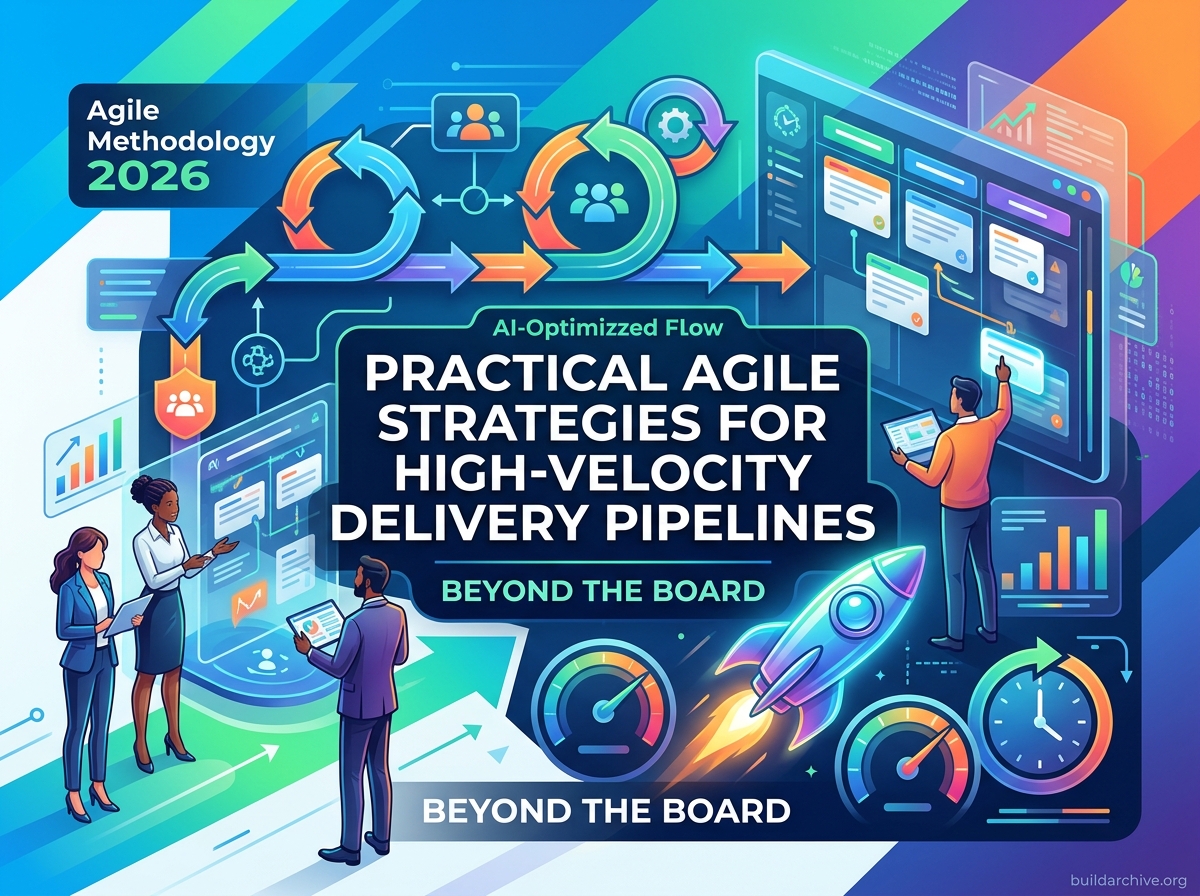
To truly master the lifecycle of software — taking it from an idea to retirement — we must bridge the gap between Agile Methodology and the technical realities of Software Architecture and Infrastructure. This post moves beyond the basic definitions of Sprints and Standups to explore the practical application of Agile principles in a modern DevOps environment. We will look at how to structure your work to support continuous delivery and how to ensure your team’s culture supports the rapid, iterative feedback loops that high-performing teams depend on.
Synchronizing Sprints with Continuous Delivery
One of the most common friction points in modern development is the “Agile-Waterfall Hybrid” trap. This happens when a team uses Scrum for development but still relies on a manual, siloed release process that occurs once every few months. To avoid this, Agile must be tightly integrated with the Delivery Pipeline. This means shifting our definition of “Done” to include successful deployment and verification in a production-like environment.
In a practical sense, this requires transforming your backlog from a list of tasks into a roadmap of deployable units. When writing user stories, the focus should be on the smallest possible increment of value that can pass through your CI/CD pipeline independently. This approach reduces risk: smaller changes are easier to test, easier to roll back, and provide immediate feedback from real-world telemetry.
The Role of “Definition of Done” (DoD) in DevOps
In a high-performing team, the Definition of Done is the bridge between the Agile process and technical excellence. A robust DoD for a modern team should include automated testing (unit tests, integration tests, and security scans must pass within the pipeline), peer review (code must be reviewed and merged according to the established branching strategy, such as trunk-based development), observability (monitoring hooks and logging must be implemented so the feature can be tracked in production), and documentation (READMEs or API docs must be updated to reflect the new changes).
The reason each of these matters is practical, not ceremonial. A story that ships without a logging hook is invisible in production — you lose the feedback loop that Agile depends on. A story without a passing CI run introduces uncertainty that compounds over sprints. The DoD is how you make “done” mean something real.
Practical Kanban: Managing Flow in Infrastructure and Ops
While Scrum works well for feature development, many teams — especially those focused on infrastructure and orchestration — find that a Kanban approach is more effective for handling unplanned work and maintenance tasks. Kanban focuses on flow rather than fixed time-boxes, making it ideal for teams managing containerized services or responding to incidents. In my own homelab, I use a lightweight Kanban board to track Proxmox VM provisioning tasks and Docker Compose updates alongside normal development work, because those tasks don’t fit neatly into two-week sprints.
To apply Kanban practically, teams must implement Work in Progress (WIP) limits. This is a critical cultural shift. By limiting how many tasks are “In Progress” at any given time, the team is forced to collaborate and clear bottlenecks before starting new work. This prevents the “started but not finished” syndrome that plagues many IT organizations. In a DevOps context, this means ensuring that a Terraform refactor isn’t left half-finished because the team got distracted by a new monitoring dashboard project.
Visualizing the Full Lifecycle
A practical Kanban board for a DevOps team should mirror the actual stages of the SDLC. Instead of simple “To-Do, Doing, Done” columns, consider a board that reflects the real delivery stages: Backlog (ideas and requirements waiting for refinement), Ready for Dev (fully spec’d tasks ready for a developer), In Progress (active coding or configuration), Peer Review / CI (code is being reviewed and passing automated builds), Staging / UAT (verified in a pre-production environment), and Production / Live (value is finally delivered to the user).
Each column boundary is a gate. Making those gates explicit on the board forces conversations about what “ready” actually means at each stage — which is exactly the kind of friction that improves quality without slowing teams down.
Practical Tips for Agile-DevOps Integration
Integrating these methodologies requires more than just changing your board layout; it requires changing how the team interacts with the code and each other. Here are three practical strategies to implement immediately.
1. Implementing Feature Flags for Decoupled Releases
Agile encourages frequent iterations, but the business may not be ready to show every iteration to the customer. By using Feature Flags, developers can merge code into the main branch and deploy it to production while keeping it hidden from the end-user. This decouples Deployment from Release, allowing the team to maintain high velocity and ship when the business is ready. Here is a minimal TypeScript example of how this looks in an Express route:
// featureFlags.ts
const flags: Record<string, boolean> = {
  newDashboard: process.env.FLAG_NEW_DASHBOARD === 'true',
};

export function isEnabled(flag: string): boolean {
  return flags[flag] ?? false;
}

// routes/dashboard.ts
import express from 'express';
import { isEnabled } from '../featureFlags';

const router = express.Router();

router.get('/dashboard', (req, res) => {
  if (isEnabled('newDashboard')) {
    return res.render('dashboard-v2');
  }
  return res.render('dashboard-v1');
});

export default router;
This works because the flag evaluation happens at request time, not at build time. You can flip the environment variable and the next request gets the new behaviour — no redeployment required. With PM2, you can reload the process cluster with zero downtime after updating the environment, making the toggle nearly instantaneous in production.
2. The “Three Amigos” Meeting for Better Stories
To prevent rework, use the “Three Amigos” strategy before a story enters development. This involves a brief 10-minute sync between a Product Owner (the “What”), a Developer (the “How”), and a QA/Tester (the “What could go wrong”). This ensures that the acceptance criteria are clear and that the automated tests planned for the CI pipeline will actually validate the business requirements. The conversation is the value — not a document or a ticket update, but a shared mental model of what done looks like before a single line of code is written.
3. Automating the Feedback Loop
Agile relies on feedback, but waiting for a bi-weekly demo is too slow. Use monitoring and logging tools to create an automated feedback loop. If a new feature is deployed and error rates spike in Grafana, that is Agile feedback. The team should be empowered to pivot immediately to fix the issue, treating operational stability as a high-priority item in the current sprint. Connecting your Node.js services to a structured logger that ships to a log aggregator means the signal exists — the cultural step is making sure the team is watching it and is empowered to act on it without waiting for the next ceremony.
Conclusion: The Path to Practical Mastery
Mastering Agile Methodology is not about passing a certification exam; it is about creating a culture where collaboration and continuous improvement are the default settings. When we treat our Agile processes as a product that needs to be iterated upon — just like our software — we unlock the ability to deliver high-quality, scalable applications with confidence.
As you move forward, look at your current workflow honestly. Are your sprints actually resulting in deployable increments? Are your silos breaking down, or are you just doing Scrum in isolation? By aligning your Agile ceremonies with the technical realities of your delivery pipeline and infrastructure, you move from theoretical agility to practical mastery.
Start small: review your Definition of Done this week and ensure it includes at least one automated check from your CI pipeline. Small, incremental changes to your process are the purest expression of the Agile mindset.